|
updated:29 July 2008
About
the EAPC
SUMMARY
download
EAPC leaflet
The European Association for Palliative Care (EAPC) was established
on 12 December 1988, with 42 founding members and following
important initiatives by Professor Vittorio Ventafridda and
the Floriani Foundation. The aim of the EAPC is to promote
palliative care in Europe and to act as a focus for all of
those who work, or have an interest, in the field of palliative
care at the scientific, clinical and social levels.
EAPC operates with the following aims:
• Promote the implementation of existing knowledge;
train those who at any level are involved with the care of
patients and families affected by incurable and advanced disease;
and promote study and research.
• Bring together those who study and practise the disciplines
involved in the care of patients and families affected by
advanced disease (doctors, nurses, social workers, psychologists
and volunteers).
•
Promote and sponsor publications or periodicals concerning
palliative care.
•
Unify national palliative care organizations and establish
an international net-work for the exchange of information
and expertise.
•
Address the ethical problems associated with the care of terminally
ill patients
Since
1990 the Head Office of EAPC has been based at the Division
of Rehabilitation and Palliative Care within the National
Cancer Institute in Milan. In 1998 the EAPC was awarded the
status of NGO – Non Governmental Organisation of the
Council of Europe, and was transformed to “Onlus”
(Non profit organisation with social utility).
By 2008 the EAPC counted individual members in 40 countries, with collective members from 42 National Associations in 25 European countries, representing a movement of more than 50.000 health care workers and volunteers working or interested in palliative care. (www.eapcnet.org/Howtojoin/memberscolllist.html)
Information about membership is available at: www.eapcnet.org/Howtojoin/Howtojoin.html
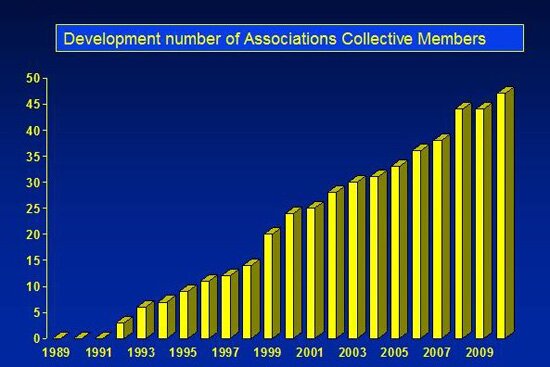
Figure
1 shows the development of the number of Associations at national
level having joined the EAPC collectively
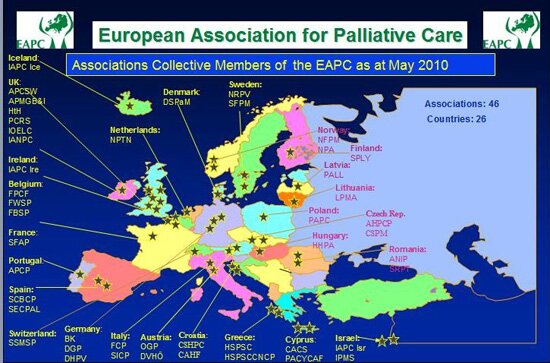
Figure
2 shows the distribution of those Associations on the European
territory.
EAPC
initiatives
The Web: www.eapcnet.org
Our
website has become a crucial communication tool to update
on the latest developments and report in detail on the activities
of EAPC.
The Scientific journals:
European
Journal of Palliative Care (EJPC)
The EAPC Journal. Editor in chief Andrew Hoy, London, UK.
The EJPC is the journal of the EAPC. It is a multidisciplinary
journal, published 6 times a year. EJPC concentrates on reviews
and current awareness of palliative care on the European scene.
Palliative
Medicine (PM)
The Research Journal of the EAPC. Editor in chief Geoffrey
Hanks, Bristol. UK.
Palliative Medicine is the leading peer reviewed research
journal of palliative care in Europe. It is published 8 times
a year and is available by subscription to the printed version
and to E access.
The “Research Network”
– Chair Stein Kaasa
The Board of Directors of the EAPC consider research a key
issue for the future of palliative care and decided in 1996
to nominate Franco De Conno, Italy to chair and put together
a Steering Committee for research. This group has organized
eleven expert working groups on a variety of topics for which
a common European position or recommendations are needed,
has carried out a cross sectional survey and initiated two
research projects (EPOS & PatC). By April 2007 13 papers
had been published which are listed and/or downloadable at:
www.eapcnet.org/publications/research.asp
Following the input of the Research Network an extended research
collaborative was established coordinated by the Pain and
Palliation Research Group in Trondheim. The collaborative’s
application to the 6th Framework Programme was successfully
evaluated in 2006 and received a 2.8 mill Euro funding from
the European Commission for a 3 year period, starting from
1 November 2006. The European Palliative Care Research Collaborative
(EPCRC) consists of eight participating centres in six European
countries: UK, Italy, Switzerland, Germany, Austria and Norway.
In June 2007 Dr. De Conno stood down from his position as
chair of the Research Network. The president thanked him in
the name of all the EAPC and nominated him Honorary Chair.
Stein Kaasa was confirmed as new Chair of the Research Network.
The
EAPC Forum on Research in Palliative Care
In December 2000 the Research Network organised the first1st
Research Forum of the EAPC held in Berlin, Germany The Forum
was such a success that the EAPC Board of Directors decided
to continue to organise those meetings every second year in
between the EAPC Congresses. View the report at: http://www.eapcnet.org/congresses/berlin2000.html
The
following countries have been hosting the Research Forum since
then:
2nd
Research Forum: Lyon, France (May 2002)
3rd
Research Forum: Stresa, Italy (June 2004)
4th
Research Forum: Venice, Italy (June 2006)
The
5th
Forum will be held in Trondheim, Norway in June 2008.
The
6th Forum will be held in the UK in 2010.
The
EAPC Congresses
Since 1990 the EAPC has organised 9 successful Congresses
with worldwide participation: Reports of previous and Web
sites of future congresses can be accessed at: www.eapcnet.org/congresses/congresses.html
1990
October: Paris, France
1992
October: Brussels, Belgium
1994
June: Bergen, Norway
1995
December: Barcelona, Spain
1997
September: London, United Kingdom
1999
September: Geneva, Switzerland
2001
April: Palermo, Italy
2003
April: Den Haag, the Netherlands
2005
April: Aachen, Germany
2007
June: Budapest, Hungary
Future
congresses :
2009
May: Vienna, Austria
The
call for the bid for the 2011 congress is open. More information
at:
www.eapcnet.org/congresses/bids&conditions.html
The Taskforces & Projects
Taskforces are generally designed to be of limited duration,
but some turn out to continue to function as small expert groups
or networks in a special field and act as advising body to the
EAPC Board of Directors.
The
EAPC Ethics Task Force on Palliative Care and Euthanasia
Chair - Lars Johan Materstvedt, Norway (www.materstvedt.net)
The paper produced by this group of experts, “Euthanasia and physician-assisted suicide: a view from an EAPC Ethics Task Force”, represents since June 2003 the official position of the EAPC on this issue. It was published originally in English and French and has, this far, been translated into Italian, Hungarian, German, Greek and Finnish. Subsequent to its publication, three additional papers were written by the Chair; the first is a "Reply to Critics", the second describes the history of the taskforce and how its work was performed, and the third deals with challenges associated with translation of the position paper. These, the translations, as well as the original paper with all commentaries from across the world, may be downloaded for free from the ethics website.
Nursing
Education Taskforce
Chair – Phil Larkin, Ireland
The
taskforce produced “A Guide for the Development of Palliative
Nurse Education in Europe” available as downloadable
pdf file in English, French, Dutch and Italian. As the fruition of
a consensus process by 120 European nurses from 13 different
countries, this document represents a solid and workable foundation
for the development of education and training in palliative
care. The authors encourage those responsible for education
and training, particularly within each national association,
to take and/or adapt this document locally, in their respective
countries. Luxembourg has taken on the recommendations in terms of their education programme for nurses.
Taskforce
on the Development of Palliative Care in Europe
Chair - Carlos Centeno, Spain
This
Task Force aims to explore, assess and comprehensively summarize
the current state of the development of palliative care in
the European region and
1. To provide reliable information on the delivery of hospice
and palliative care in Europe in a manner relevant to the
EAPC; to intergovernmental organisations and to national and
regional governments
2. To explore the current organisation of hospice and palliative
care in Europe considering political and social issues; healthcare
policies, and the availability of palliative care resources
countrywide
3. To facilitate access to information and communication between
hospice and palliative care associations and societies that
operate across Europe
4. To aid the identification of key persons who have studied
the development of hospice and palliative care in their own
settings and who may provide country specific data to assist
policy makers, planners and professional associations .
The publication of a printed and electronic Atlas in 2007,
is the result of the work of this taskforce. The study has
succeeded in compiling country reports for 42/52 participating
countries (www.eapcnet.org/Policy/CountriesReport.htm)
which results are presented in The Atlas in a very attractive
way with tables and maps. The EAPC Task Force has worked in
the last four years on the project and its main results, the
Atlas, is representing the largest palliative care research
collaboration of its kind, carried out an assessment of palliative
care development taking into account political, social and
health care policy. To access the details and the report,
read more at www.eapcnet.org/Policy/EAPC.Atlas.htm
A second taskforce building on and updating the results of
this survey. Will start its work in 2007.
Task
Force CEE & FSU Newsletter
Chair - Katalin Hegedus, Hungary
The main goal is to further develop the monthly online CEE & FSU (Central and Eastern European and Former Soviet Union) Palliative Care Newsletter in English and Russian languages in order to cover palliative care activities in the countries of the region. A further aim is to increase the participation of these countries in international associations, movements and actions.
One of the results in 2007 is that there were 329 registered participants from the CEE&FSU countries at the 10th Congress of the European Association for Palliative Care in Budapest. Another result is that after the congress 3 new national associations became EAPC collective members from the region.
The issues of the Newsletter are distributed to almost 1200 e-mail addresses. The English version of the Newsletter has an average 600-1200 readers per month, and the Russian version about 60-120 readers.
Physician
Education Taskforce Chair – Frank Elsner, Germany
The European Association for Palliative Care (EAPC) has always regarded the education of health care professionals in Palliative Care as one of the most important objectives to promote of Palliative Care in Europe. A taskforce was established to work on recommendations for curricula on under- and postgraduate medical education in Palliative Care. The taskforce has finished a paper called “Curriculum in Palliative Care for Undergraduate Medical Education - Recommendations of the European Association for Palliative Care (EAPC)” which has already been published on the EAPC-website at:
eapcnet.org/download/forTaskforces/PhysiciansTF/PC-Curr-UndergraduateMedEdu.pdf
A corresponding curriculum for postgraduate education is on the verge to be finished.
In the future the task force will have to work on the promotion and dissemination of these curricula and also on how to adopt them in the individual and different national settings. Furthermore regular updates of the curricula will be necessary to guarantee an ongoing high level of quality of education in the field.
Taskforce
on National Association Organizations Developments
Chair – David Praill
This task force was established in collaboration with Help the Hospices, in Spring 2006. Its aim is to survey national association organizational development and support their needs according to their level of development. The survey was conducted and data presented at the EAPC conference Budapest in 2007. It provided an insight into the issues, problems and solutions associated with the work of national associations, their relationships to local health systems and their impact on the provision and motivation for palliative care service delivery.
The survey highlighted the lack of development of national associations and need for a training programme to be developed in key areas such as fundraising and advocacy. As a result, fundraising training occurred at the EAPC conference in Budapest in 2007. In October 2007, a high level advocacy meeting occurred at the European Union to present results of the survey and palliative care development in Europe. This led a letter from EAPC to EAPC members to write to MEPs about the issue and a presentation in February 2008 on key issues for palliative care as part of the Slovenian EU presidency for 2008.
Planning is now occurring to provide further support to national associations in Europe, including a review of what national associations are doing to scale up palliative care and development under the auspices of the “Budapest Commitments”. This will be presented at the EAPC conference in Vienna 2009.
Taskforce
on European Palliative Stage Opportunity (EPSO)
Chair – Tine de Vlieger
This
taskforce has arisen out of initial work undertaken by the
NTN Dutch palliative care network and the Nursing education
group. Its aim is to prepare a web-based catalogue for people
wishing to undertake clinical experience in another country.
Guidelines and evaluation materials for both applicant and
host centre are currently being prepared and will be finalized
by November 2006, it is planned to publish the documents and
information on the EAPC website under the direction of the
group. Host centres will initially be identified by the National
Association members and then approached to participate in
the project. The outcome of the project will be a sustainable
information base for potential clinical experiences to improve
the sharing of best practice across Europe.
Solid
facts in Paediatric Palliative Care – EAPC Taskforce
Chairs - Franca Benini & Huda Huyer Abu Saad
In the last decade palliative care has witnessed an expansion in knowledge and provision of services in many countries worldwide, while palliative care for children has not had the same attention and growth. Globally, very few children actually have access to palliative care and as a consequence, they face disease and death without dignity, in adult facilities not suitable to their age, without appropriate management of symptoms or clinical, psychological, religious, social and organizational support and assistance.
The purpose of the EAPC Taskforce: “Palliative Care in Children” is to examine and describe the state of the art and need for palliative care in children through a systematic and comprehensive analysis of scientific evidence, anecdotal experience, suggestions and contributions from leading international experts in different fields of paediatric palliative care in order to formulate recommendations for health care professionals and policy makers.
Completed work:
IMPaCCT: standards for paediatric palliative care in Europe.
A document prepared by the Steering Committee of the EAPC task force on palliative care for children and adolescents.
European Journal of Palliative Care, 2007; 14(3): 109–114
The document has been translated to different languages and will be posted on EAPC website at www.eapcnet.org/projects/Paedriatic.asp
Current work:
‘Palliative Care for Infants, Children and Young People - THE FACTS’
‘Train the trainer course on paediatric palliative care’
A
new Taskforce on: Palliative Care for older People: Better
Practice
Chair
Irene Higginson
A new EAPC task force was established in September 2007 aiming to improve palliative and end of life care for older people by publishing a high profile guide of examples of good and promising practice around Europe. This project seeks to build on two previous guides: Palliative
Care: The Solid Facts (Davies & Higginson, 2004) and Better
Palliative Care for Older People (Davies & Higginson, 2004)) to provide examples of better palliative care practice, to aid those involved in planning and supporting care-orientated services in the most appropriate and effective way. A group of international contributors are participating in planning and developing the guide.
Examples of better practice have been so far obtained using two methods: literature reviews and a call for examples. Thirteen international and national organisations participated in the call for examples. A preliminary literature review of palliative care interventions in care homes has produced 16 potential examples of better practice. In addition, we found examples of better palliative care practice for older people in other settings. A wide range of diverse examples of better practice in palliative care for older people have been identified, such as educational and training programs, care pathways, quality improvement interventions, multidisciplinary palliative care teams, support for friends and carers and regional initiatives, and the results of our current review have informed the development of other systematic reviews. Cross-European data have also been collected on a number of parameters, such as place of death, palliative care workforce and aging populations, which will be included in the guide. A draft of the introduction to the guide is underway and a poster describing the development of the guide has been presented in May 2008 at the EAPC conference in Trondheim.
A group meeting is scheduled soon in Rome where we will be finalising our selection criteria based on
(i) quality of evaluation;
(ii) relevance to older people and
(iii) relevance to Europe. We will also begin to choose examples for the guide and develop our dissemination strategy.
If you know of an example which you would like to be considered for the guide please visit our page for more details.
The work of the taskforce is supported by the Maruzza Lefebvre D’Ovidio Foundation.
Milan, Italy, March 2008
Amelia Giordano & Heidi Blumhuber
EAPC Head office
National Cancer Institute
Via Venezian 1, 20133 Milano, Italy
amelia.giordano@istitutotumori.mi.it & heidi.blumhuber@istitutotumori.mi.it
|