|
President's message 2005
|
|
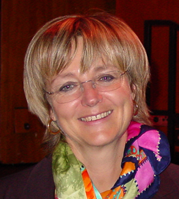
By Marilène Filbet, President EAPC -2005-2007
Welcome message from the new President
|
It is a great honour to have been appointed President of the EAPC, and to follow in the footsteps of Professor Ventafridda, Professor Hanks and Professor Kaasa. I shall make every effort to prove myself worthy of this honour and to follow the good examples set by my predecessors.
Thanks to them, the EAPC has grown in stature and now represents, as it stands in June 2005, 32 associations, collective members from 21 different countries and a total movement of around 50,000 people in Europe. It is necessary to continue to make progress in improving the quality of palliative care throughout Europe, and we have to face up to a number of challenges in the development of this field.
The field of palliative care has extended well beyond patients suffering from cancer; the reality of an aging population must lead to progress in palliative care for the elderly and support for those close to them. Palliative care must also be of benefit to those suffering from pathologies other than cancer, as well as to those with AIDS and severe disabilities.
The ways of organising and financing healthcare are different in each of the countries in Europe and, rather than putting forward a single model for the development of palliative care, we must establish standards that can serve as common reference points. Similarly, in the interests of fairness, we should affirm the necessity for all people to have access to palliative care services, whatever their financial situation may be, and we should promote among the various European institutions access to palliative care services as a right of all citizens.
Another challenge is that of the diversity within Europe – the various professionals and volunteers do not always have the same training or the same roles in each country and, 178 furthermore, language barriers and cultural barriers can limit exchanges. The socio-economic changes in our developed countries, the heavy financial burden of old age, individualism and the loss of cultural and religious bases, have contributed to a strong movement – promoted by the media – in favour of the legalisation of euthanasia. We must remain vigilant in our defence of the values that unite us and speak up for our more fragile patients.
It is these differences that give our association its richness and it is necessary to step up exchanges, establish links and build bridges between different countries, between professionals and volunteers, between different specialist fields, and with other European organisations, particularly those operating in the fields of pain management, care of the elderly and of children, cancer and bereavement. We must work creatively!
We have the means to meet these objectives, such as task forces in the areas of education, standards, ethics and the development of palliative care in Europe, and a research network. These groups must be very open to different professionals and to different countries so that each member organisation of EAPC, as well as its individual members, feel that they are represented and involved in our association. Each member of the EAPC can take the initiative to create a task force, and the publications of the various groups will be available on our site.
By way of our communication tools, such as the website and the EAPC’s journals, the European Journal of Palliative Care and Palliative Medicine, you are invited to join us and to have your say. Do not hesitate to send us your proposals for publications, your experiences and your comments. Do not forget our forthcoming important meetings: the research forum in Venice in 2006 and the next congress in Budapest in 2007. All the details that you need in order to take part and send in your abstracts are available on our website: eapcnet.org.
I hope that each one of you will have been able to organise or participate in an event to help make the first day for palliative care on 8 October 2005 a success.
I look forward to hearing from you.
Marilène Filbet, President of the EAPC
|