
 |
A personal note
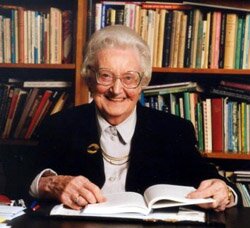
It was with great sadness that I learnt that Dame Cicely Saunders had died. The palliative care movement has lost a mother of sorts, who was a role model, and always encouraged new initiatives within the field of palliative care, giving each the impression of being unique. She leaves throughout the world – no matter the cultural, religious or economic circumstances – hospices for caring and supporting terminally ill people. These places are themselves catalysts for the spread of palliative care. The obituaries in different newspapers retrace the unusual professional career of this woman determined to put into practice her vision for caring for people at the end of life. Philip Larkin has written some thoughts on behalf of the EAPC and I would like to thank him for that. I would also like to share with you a personal recollection; I met Dame Cicely at the two-day French conference held at St Christopher’s hospice when she came to talk to the participants. The first time I met her left a lasting impression because in her face there was lots of energy, because she was very attentive despite my laborious English and this capacity to be open to others was a lesson for me. Every year, the palliative care course at the university begins with the history of palliative care and the life of Cicely Saunders – this year we will be grieving.
Marilène Filbet, President of the EAPC
Tribute to Dame Cicely Saunders – a life well-lived.
The recent death of Dame Cicely Saunders offers a chance for reflection on the immense contribution that her life’s work has meant to medicine and health care at a global level. Internationally recognised as the founder of the modern Hospice movement, her vision for end of life care echoes her deep Christian ideals and respect for the innate humanity within each of us. In paying tribute to her lifetime’s achievement, we are aware that the good care which is today commonplace throughout many countries was only possible through the determination and strength of one woman’s mission.
Of course, Palliative Care has come to mean so much more than a Christian approach to care, although its roots growing from Dame Cicely’s spiritual journey should not be forgotten. The modern clinical application of her caring philosophy moves beyond borders, creeds and politics. Today, palliative care provides a framework in which cure and care are finely tuned to meet the needs of people with a broad spectrum of advanced disease, offered in a multiplicity of ways, each reflecting a different cultural heritage, but aspiring to the principles she laid down in that first modern hospice, St. Christopher’s in England.
Palliative Care in Europe owes a debt of gratitude to Dame Cicely for her unending support to the local initiatives which grew from first contacts with both St. Christopher’s Hospice and the lady herself. These became the seeds of the hospice movement in many European countries. In her own writings (1), one reads how these seeds were sown; letters of encouragement, answers to problems given, faith restored in a mission where difficult challenges existed. Dame Cicely Saunders provided that first beacon and others that today represent our own European story took it up. Her ongoing correspondence with the founding members of The European Association for Palliative Care and her closing address to the 1992 EAPC Congress in Belgium gave encouragement that their vision for a European network was justified and necessary. There are many others from all over Europe who have their own story who would acknowledge their special debt to her. We, in the EAPC are part of that acknowledgement.
What is perhaps her greatest legacy is that she never claimed ownership of palliative care. Rather, she shared her vision with others and enabled them to adapt and create palliative care within the systems and structures that existed within their respective countries. Her story of the development of St. Christopher’s Hospice is evidently one of triumph over adversity, a fundamental belief in the adage of the 12th Century English mystic, Julian of Norwich that “all shall be well”. Each country in Europe faced similar challenges in developing its palliative care service but her support gave the necessary encouragement that what they were doing was fundamentally right. It is equally commendable that her professional life and her experiences as a nurse, social worker and doctor could speak to a wide audience. But her message was always simple. Challenge ignorance and fear through sound clinical knowledge. Provide the evidence to support the benefits of good palliative care Demonstrate the effectiveness of your care through good management and robust research. Watch carefully and Guide safely.
Today we, The European Association for Palliative Care, represent almost 50,000 people from 31 countries who believe that patients with incurable disease can, in Dame Cicely’s own view “ live until you die”. Being a part of the vision of palliative care means that we carry the legacy of David Tasma to Cicely Saunders – to provide a “window” to offer light to the journey our patients must take. Each of us who will carry a personal memory of Dame Cicely Saunders will also carry that light to the next generation of palliative care practitioners for whom she will be a part of history. If we take the time to consider the gifts she has left us for the future, her spirit will continue to guide us and in saying our sad farewell, we can thank her for a life well lived.
Phil Larkin, Vice-President of the EAPC
(1) Clark, D. (2002): Cicely Saunders Founder of the Hospice Movement: Selected Letters 1959-1999. Oxford University Press, U.K.